





Introduction
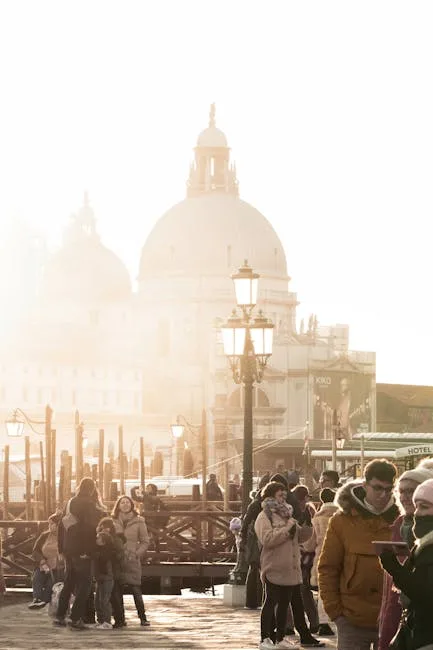
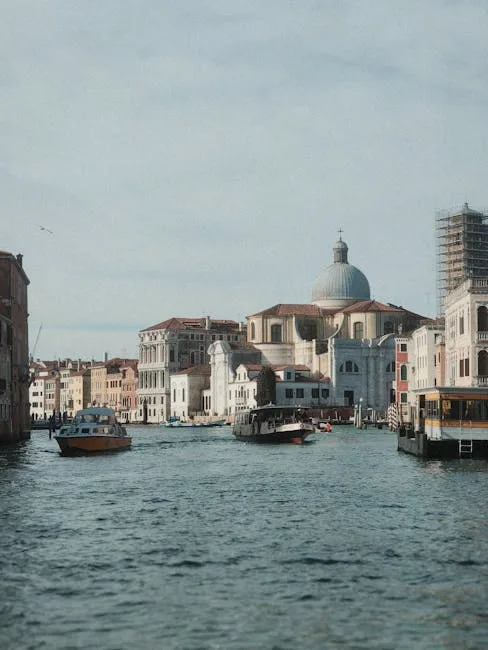
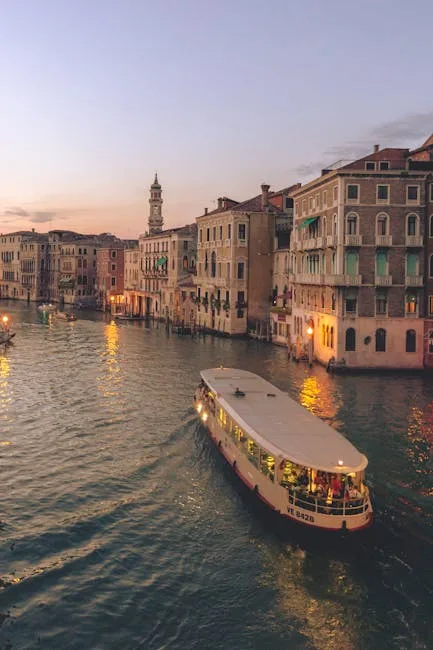
Venice is a city made to be seen from the water. Its palaces, bridges and colorful façades reveal themselves best in motion, from a vaporetto — the public water buses that weave through the canal network. With a camera in hand, boarding a vaporetto opens up unique possibilities: dynamic angles along the Grand Canal, dramatic backlight at sunset, ever-shifting reflections on the water, and candid scenes of daily life with gondoliers, delivery boats and locals. But shooting from a moving boat also calls for technical and logistical adjustments — stabilization, lens choice, anticipating turns, handling reflections, and being considerate of fellow passengers.
This article aims to give you practical, immediately usable tips to improve your photos from a vaporetto in Venice. We cover gear selection, shooting settings, the best routes and stops to frame iconic sights (St. Mark’s Basilica, Doge’s Palace, Rialto Bridge, Gallerie dell’Accademia, Santa Lucia station…), ideal times of day, and local practical tips like buying ACTV tickets, protecting your gear, and how to negotiate crowds to get a clear view.
We include precise addresses (Piazza San Marco, 328 — St. Mark’s Basilica; Palazzo Ducale, Piazza San Marco 1; Ponte di Rialto, 30125 Venezia VE; Stazione di Venezia Santa Lucia, Fondamenta Santa Lucia, 30121 Venezia VE), opening hours and prices in euros for transport and attractions, plus recommendations for shooting in all weather conditions. Whether you’re an enthusiastic amateur, a curious traveler or a pro, these tips will help turn a vaporetto ride into a string of powerful, memorable images.
Before you board, ask yourself a few questions: which lenses will you take? Do you want wide scenes or architectural details? Are you after golden-hour light or harsh midday contrast? Answering these ahead of time will make you more reactive and improve your results. Finally, photographing from a vaporetto is also a human experience: respect public space, be mindful of other passengers, and know when to get off to capture a scene from a bridge or the bank.
Choosing the Right Gear and Settings for the Vaporetto
The right gear makes a big difference when shooting from a public boat. Start with a lightweight, versatile camera: a mirrorless full-frame or APS-C, or even a capable advanced compact. Recommended lenses cover a practical focal range: a 24–70mm for most scenes, a 35mm prime for natural perspectives and portraits, and a 70–200mm or 100–400mm to isolate distant details (sculptures, signs, people on the quays). For architectural details on Venetian palaces (for example, the façade of the Doge’s Palace), a 50mm or 85mm can produce a very elegant look.
Technical settings: your priority is avoiding motion blur caused by the vaporetto’s movement. Use a shutter speed of at least 1/500s for moving subjects, and around 1/250s for relatively still subjects in bright daylight. Raise ISO when needed; modern bodies handle high ISOs well up to 3200, or even 6400 if you plan to crop slightly later. In low-light situations (foggy mornings, late afternoon), switch to Aperture Priority (A/Av) to control depth of field and let the camera handle shutter speed. Favor apertures around f/4–f/8 to keep enough sharpness while getting pleasing separation.
Stabilization: if your lens or body has stabilization (IBIS or OSS), turn it on. For very slow shutter speeds, brace your arms on the rail or the boat’s edge to gain steadiness. If you’re shooting with a smartphone, invest in a small handheld gimbal — it’ll help enormously for tracking shots along the Grand Canal.
Other useful accessories: a microfiber cloth to wipe salty splashes off the lens, a waterproof camera bag or rain cover to protect your kit, and a short strap or sling to keep the camera close, reduce the risk of dropping it and make quick framing easier. Avoid tripods on the vaporetto — they take up space and are unstable — unless you’re on a large private boat where they’re safe and allowed.
- Lenses: 24–70mm, 35mm, 70–200mm.
- Settings: 1/250–1/500s in daylight, ISO as needed, Aperture Priority for low light.
- Stabilization: enable IBIS/OSS, brace against the railing, use a gimbal for smartphones.
- Accessories: microfiber, rain cover, short strap.
Essential Lines and Stops for the Best Views
Knowing the ACTV lines and strategic stops turns your ride into a sequence of photographic frames. The two most photogenic lines are Line 1 (the slow route along the Grand Canal, stopping at many points) and Line 2 (faster, sometimes with direct runs). Here are some stops and practical tips to make the most of each.
Piazzale Roma (Piazzale Roma, 30135 Venezia VE) and Venezia Santa Lucia (Fondamenta Santa Lucia, 30121 Venezia VE): these two termini are perfect places to start or finish a route. From Venezia Santa Lucia station you get an instant view of the Grand Canal entrance and the façades lining it. For a wide-angle composition, sit on the left side heading into the Grand Canal if you depart from Piazzale Roma.
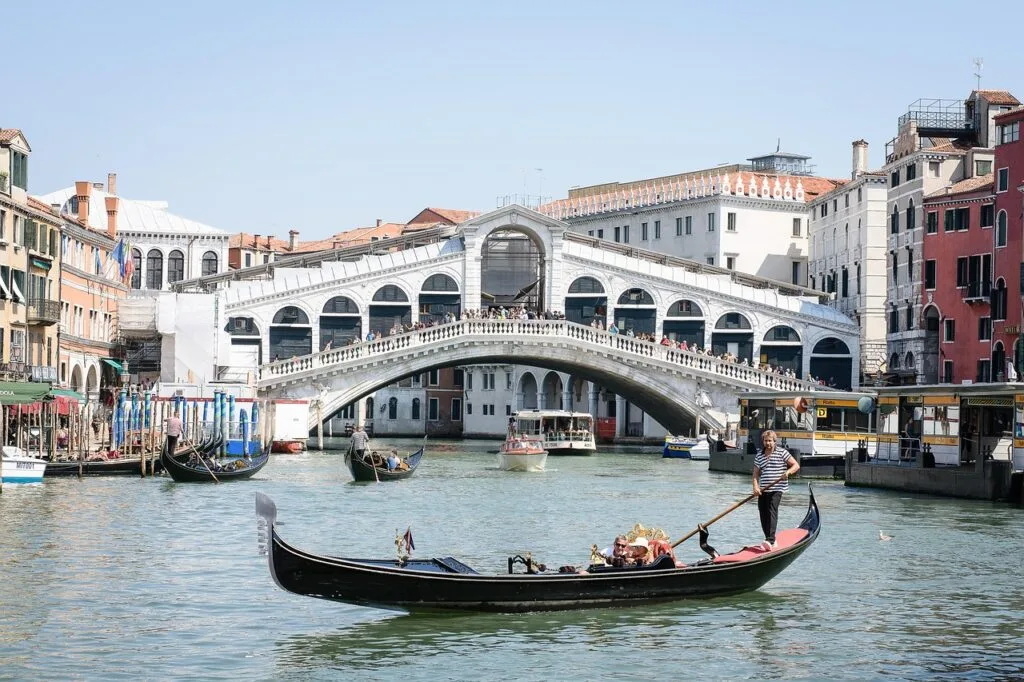
Ponte di Rialto (Rialto Mercato stop, Ponte di Rialto, 30125 Venezia VE): one of the most famous spots. Get off at the mercato if you want to capture the bridge from the bank, or stay on board for a longitudinal view of the bridge with boats in the foreground. The Rialto market (Mercato di Rialto, Campo della Pescaria) is just a few steps away — perfect for colorful market shots.
 Click here to book a one-hour Grand Canal boat tour
San Marco / San Zaccaria (Piazza San Marco, 328 – St. Mark’s Basilica): the San Zaccaria stop drops you a short walk from St. Mark’s Basilica (Basilica di San Marco, Piazza San Marco, 328, 30124 Venezia VE) and the Doge’s Palace (Palazzo Ducale / Doge’s Palace, Piazza San Marco, 1, 30124 Venezia VE). The basilica generally opens around 9:30–17:00 (check for seasonal changes and religious services); the Doge’s Palace is typically open 8:30–18:00 (last entry around 17:00) with an entrance fee near €25–30. Photograph the façade from the water at sunrise to avoid crowds and enjoy warm side-lighting.
Click here to book priority access to the Doge’s Palace
Giudecca (Giudecca Palanca stop or Zitelle): offers a unique perspective on the island and a clear view of St. Mark’s Square from the opposite bank. It’s perfect at sunset when the city silhouette cuts into the sky. For more contemporary views, head to the Fondamenta delle Zattere (Lungomare degli Angeli) on the Dorsoduro side to capture boat movement.
Click here to enjoy a sunset cruise in the Venice lagoon
Murano and Burano: although further out, the lines to Murano (stop Museo del Vetro / Museo del Vetro, Fondamenta Marco Giustinian, 10, 30141 Murano VE; typical opening 10:00–18:00, ticket around €8–€10) and Burano offer highly photogenic, colorful scenes. In Murano, boats pass near glass workshops — ideal for capturing artisans and reflections. Burano, with its painted houses, is worth the trip; get off at Fondamenta di Burano and wander for compositions of colorful façades and peaceful canals.
Click here to discover Murano and Burano on a boat excursion
Composition Techniques and Managing Light on the Move
Shooting from a vaporetto requires quick scene reading and composition choices that suit movement and cramped space. Start with wide frames to set the scene: the Grand Canal delivers spectacular perspectives with palaces lined up like Ca’ d’Oro and Ca’ Rezzonico. Ca’ d’Oro (Strada Nuova, 6004, 30121 Venezia VE) is often photographed from the water to show its lace-like stonework.
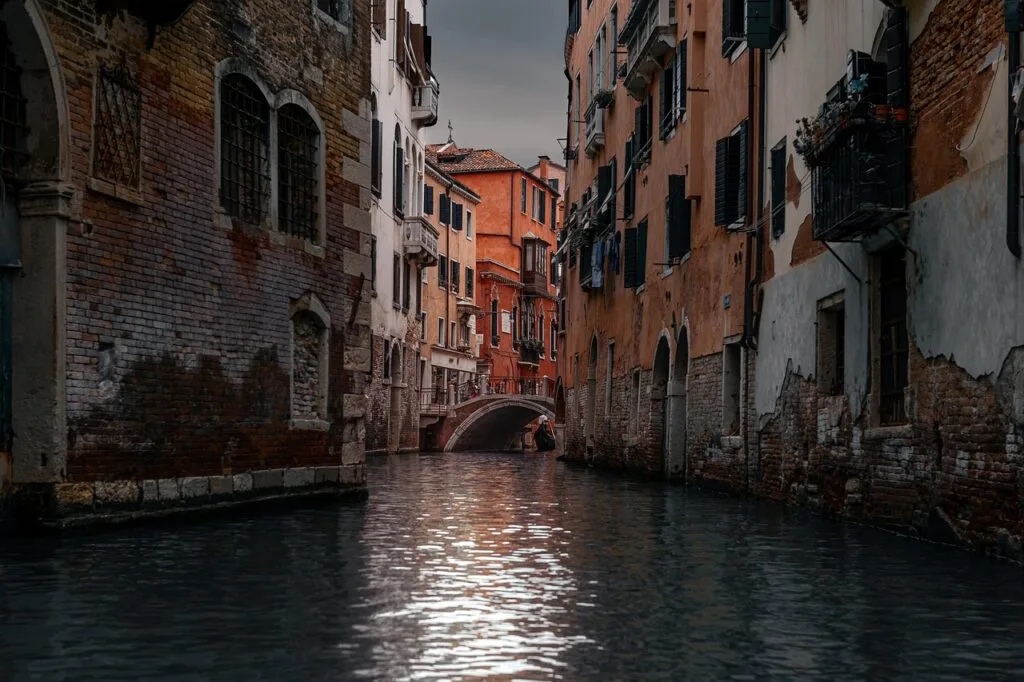
Rule of thirds and leading lines: place the horizon or waterline on the top or bottom third depending on whether you want to emphasize sky or façades. Canals naturally create leading lines — position them diagonally to energize the composition. Venetian architecture repeats windows, balconies and cornices: use those patterns to build visual rhythm.
Light: light changes fast on the water. The best times are golden hour (sunrise/sunset) and blue hour (just after sunset). Morning side light brings out stone textures and façades; late afternoon coppery reflections on the water create a romantic mood. At midday, look for backlit compositions to capture silhouettes and light halos, or use a polarizing filter to cut distracting reflections and boost color saturation.
Anticipate scenes: vaporetti pass popular sites often — prepare your framing in advance. If you want to capture the Doge’s Palace from the water, be ready to shoot when the boat is parallel to the façade. Use burst mode to improve your chances of nailing a sharp image. For portraits of passersby or candid life shots, a 35–50mm focal length keeps you close without intruding.
Post-processing: quickly correct perspective and verticals (façades can lean depending on your angle). Work on clarity and contrast to reveal textures, and pull down highlights to recover sky detail when water is reflecting strongly. For color, a slight boost in vibrance usually restores Venice’s unique palette without making the scene look artificial.
For architectural details and tight shots, consider a fast prime and focus carefully on patterns (windows, marble, mosaics). Correct perspective when needed and favor texture and contrast to make ornaments pop.
Local Practical Tips, Safety and Photo Ethics
Venice is a living city where photography sometimes interferes with daily life. Respect residents and public space. Don’t block walkways on quays or at vaporetto stops. If you use a long lens to photograph people, remember consent rules: avoid close portraits without permission, especially of locals and children.
Gear security: keep your bag zipped and accessories within reach. Vaporetti are generally safe, but unattended pockets can attract pickpockets at busy stops (Piazza San Marco, Ponte di Rialto). A cut-resistant strap or anti-theft bag is recommended. In rain or spray, protect your kit: a rain cover and silica gel packs help prevent corrosion.
ACTV tickets and fares: buy your tickets in advance or grab a day pass. As a guide, a 75-minute ACTV ticket costs about €2.50, a 24-hour pass around €25, a 48-hour pass about €35 and a 72-hour pass around €50. Prices can change; check the official ACTV site (actv.it) for up-to-date rates and subscriptions. Keep your ticket with you: inspections are frequent and fines can be steep.
Opening hours and site access: St. Mark’s Basilica (Basilica di San Marco, Piazza San Marco, 328, 30124 Venezia VE) has variable hours — generally 9:30–17:00 (confirm for season and ceremonies). The Doge’s Palace (Piazza San Marco, 1) often opens 8:30–18:00 (tickets ~€25–30). Museo Correr (Piazza San Marco, 52) follows similar hours. For indoor visits, buy tickets online to skip long queues and plan your vaporetto timings accordingly.
Ethics and preservation: don’t touch sculptures or fragile surfaces to “set up” a shot. Respect closed zones and local drone regulations — drone use in Venice’s historic center is strictly controlled and often forbidden without authorization. Think about sustainability: minimize plastic use, carry your trash, and support local cafés and artisans.
- Respect local life and private property.
- Protect your gear against water and theft.
- Buy official ACTV tickets and keep them on you.
- Avoid unauthorized drone use.

Recommended Photo Routes for a Day on the Vaporetto
Here are three practical routes designed to maximize light and photographic opportunities in a single day, starting from Piazzale Roma or Santa Lucia Station. Each route includes stops, approximate durations and compositional tips.
Route 1 — Classic Grand Canal (morning): Depart Venezia Santa Lucia → follow Line 1 toward San Marco. Get off at Rialto (Ponte di Rialto) to photograph the bridge from the bank and the boats. Take the vaporetto on to San Zaccaria for St. Mark’s Basilica and the Doge’s Palace. Duration: 2–3 hours. Tip: favor sunrise for soft colors and fewer people. Key addresses: Ponte di Rialto, 30125 Venezia VE; Basilica di San Marco, Piazza San Marco, 328.
Click here to book a boat tour on the Grand Canal
Route 2 — Giudecca and waterfront (late afternoon / sunset): Depart Piazzale Roma → head to Giudecca (Line 2 or 1 depending on schedule) → stop at Zitelle or Palanca. Walk along the Fondamenta delle Zattere for diagonal views of façades and the basin. Cross to the opposite bank to capture St. Mark’s at sunset. Duration: 3–4 hours. Tip: use slower shutter speeds to capture light trails and golden reflections.
Route 3 — Murano and Burano excursion (full day): Take the vaporetto to Murano (Museo del Vetro stop) early to enjoy the glass workshops and soft morning light. Continue to Burano for the colorful houses and tranquil canals. On the return to Venice you’ll have high-contrast images that mix craft and color. Duration: full day. The Museo del Vetro (Fondamenta Marco Giustinian, 10, 30141 Murano) pairs well with a vaporetto trip. Museum ticket ~€8–€10; check opening times (often 10:00–18:00).
Click here to book a half-day Murano and Burano excursion
Conclusion
Photographing Venice from a vaporetto brings together technique, anticipation and respect for the place. By mastering your gear, choosing the right ACTV lines and planning around the light, you can turn a public ride into a series of striking images — from the grandeur of the Doge’s Palace (Piazza San Marco, 1, 30124 Venezia VE) to the vivid houses of Burano, and the everyday scenes on quays and markets. The practical tips in this article will help you approach each shot with confidence: stabilization, recommended focal lengths, exposure settings, and dynamic compositions. Don’t forget the human element too: respect locals, protect the environment and check local rules (opening hours of St. Mark’s Basilica, museum prices or boarding conditions).
Venice constantly changes with light and tide; patience is your best ally. Start early to capture the sleeping city at sunrise, use golden hours for dramatic backlight, and finish at dusk when city lights dance on the canals. To preserve the feel of your trip, complement your city shots with details: signs, wall textures, artisans’ faces, and blown-glass bubbles in Murano. Those images tell Venice’s story beyond the postcard.
Click here to book a professional photoshoot in Venice
Click here to book a professional photoshoot in Venice
Safe travels and happy shooting! Always check ACTV and museum schedules and fares, protect your gear from water and theft, and respect the life and fragility of this one-of-a-kind city.